India is a nation defined by its unity in diversity. From the snow-capped peaks of the Himalayas to the lush greenery of the Western Ghats, the country is divided into a colorful tapestry of states, each with its own unique culture, language, and governance. The official list of 29 states of India isn’t just a geographical breakdown—it’s a vivid portrayal of the nation’s heritage, political legacy, and regional identities. In this article, we present 29 fascinating facts about India’s states and dive deeper into what makes each of them so important.
Understanding the List of 29 States of India
India is a federal republic comprising 29 states and several union territories. Each state functions under its own government, headed by a Chief Minister and governed through a legislative assembly. The distribution of states is not random but based on historical developments, administrative efficiency, cultural diversity, and linguistic demographics.
This framework allows India to manage its immense diversity and population across regions. Every state has jurisdiction over specific matters listed in the State List of the Constitution, giving them autonomy over areas like agriculture, police, and local governance.
Historical Context Behind the List of 29 States of India
The current structure of states in India has evolved significantly since the country gained independence in 1947. Initially, the country consisted of provinces and princely states inherited from British rule. In 1956, the States Reorganisation Act laid the foundation for dividing states based primarily on linguistic lines.
This was a monumental move, as it acknowledged regional identities and eased administrative burdens. Over the years, more changes followed. For instance:
- Chhattisgarh was formed in 2000 from Madhya Pradesh.
- Uttarakhand was also carved out of Uttar Pradesh in 2000.
- Telangana was created in 2014, making it the newest state in India.
These changes weren’t just political adjustments—they represented deeper aspirations of identity, governance, and cultural preservation.
Detailed List of 29 States of India with Their Capitals
Here is a state-by-state breakdown of the 29 states of India and their respective capitals, along with a glimpse into what makes them stand out:
- Andhra Pradesh – Amaravati
Known for its rich Telugu culture and agriculture-driven economy. - Arunachal Pradesh – Itanagar
Easternmost state, rich in tribal traditions and natural beauty. - Assam – Dispur
Famous for its tea plantations and unique Bihu celebrations. - Bihar – Patna
Ancient hub of learning and culture, with deep historical roots. - Chhattisgarh – Raipur
Rich in forests and minerals, with vibrant tribal art forms. - Goa – Panaji
A beach paradise blending Indian and Portuguese cultures. - Gujarat – Gandhinagar
Industrial powerhouse and birthplace of Mahatma Gandhi. - Haryana – Chandigarh
Major contributor to India’s food production and rural strength. - Himachal Pradesh – Shimla
Popular hill state with breathtaking mountains and tourism. - Jharkhand – Ranchi
Abundant in minerals, forests, and indigenous heritage. - Karnataka – Bengaluru
Silicon Valley of India, leading in tech innovation. - Kerala – Thiruvananthapuram
High literacy and health standards with lush backwaters.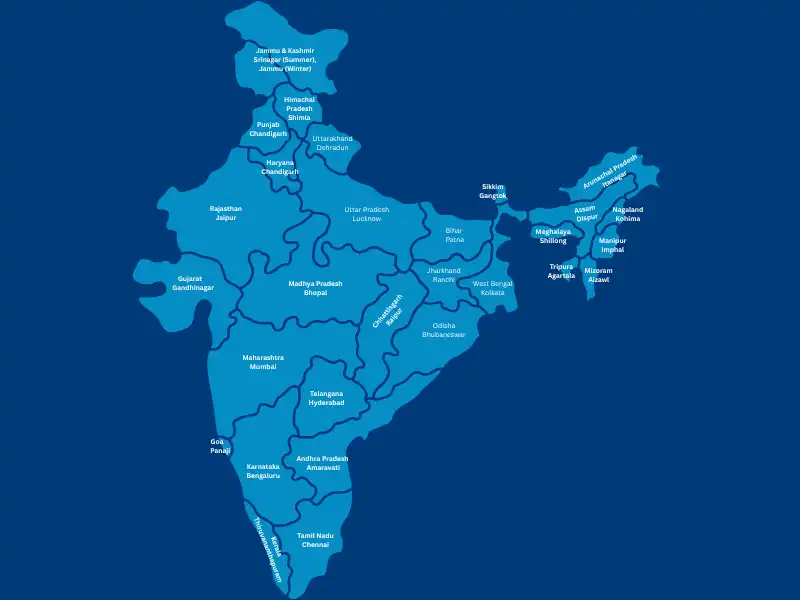
list of 29 states of india - Madhya Pradesh – Bhopal
The heart of India, home to national parks and temples. - Maharashtra – Mumbai
Financial hub, housing Bollywood and global trade centers. - Manipur – Imphal
Known for classical dance, natural beauty, and sports talent. - Meghalaya – Shillong
“Abode of clouds,” renowned for music, rain, and traditions. - Mizoram – Aizawl
Peaceful hill state with a strong Christian cultural influence. - Nagaland – Kohima
Celebrated for its Hornbill Festival and tribal pride. - Odisha – Bhubaneswar
Temple state with a rich coastal culture and tribal diversity. - Punjab – Chandigarh
Land of warriors, bhangra, and agricultural excellence. - Rajasthan – Jaipur
Desert state rich in royal history, palaces, and forts. - Sikkim – Gangtok
Tiny Himalayan gem combining Buddhist heritage and ecology. - Tamil Nadu – Chennai
Epicenter of classical arts, Dravidian culture, and temples. - Telangana – Hyderabad
India’s newest state, known for IT hubs and historic architecture. - Tripura – Agartala
Home to beautiful palaces, temples, and tribal communities. - Uttar Pradesh – Lucknow
Political heavyweight with Mughal, Hindu, and colonial influences. - Uttarakhand – Dehradun
Spiritual gateway with pilgrimage centers and natural beauty. - West Bengal – Kolkata
Literary and cultural capital, rich in colonial and artistic history. - Jammu & Kashmir – Srinagar (Summer), Jammu (Winter)
Region of majestic landscapes and complex political backdrop.
Cultural Significance of the List of 29 States of India
Each state in India contributes to the nation’s collective identity in profound ways. From linguistic diversity—like Tamil in the south and Punjabi in the north—to vibrant festivals such as Pongal, Durga Puja, and Lohri, every state adds color to the Indian cultural canvas.
For example:
- Rajasthan hosts desert festivals that showcase folk art.
- Kerala celebrates Onam with boat races and flower carpets.
- Assam’s Bihu reflects the agrarian calendar.
- Gujarat lights up during Navratri with garba dance.
Even culinary traditions vary—dosa in Tamil Nadu, litti-chokha in Bihar, fish curry in Bengal, and biryani in Hyderabad. Knowing the list of 29 states of India offers insight into these distinct experiences that coexist under one flag.
Importance of Knowing the List of 29 States of India
Whether you’re a student preparing for competitive exams, a traveler looking to explore India, or a citizen wanting to understand your country better, the knowledge of all 29 states is invaluable. It enables better understanding of regional perspectives and helps promote mutual respect among diverse populations.
Administratively, knowing which laws and schemes apply to each state can help you navigate government systems better. Culturally, it fosters appreciation for the country’s rich pluralism and interconnectivity.
Conclusion: Why the List of 29 States of India Matters
India’s strength lies in its diversity, and the list of 29 states is the structural framework holding this diversity together. Every state is more than a dot on the map—it’s a community, a culture, and a contribution to the greater Indian story. As India continues to grow and evolve, staying informed about its states helps one stay connected to its soul. So next time you hear about a state, you’ll know its name, capital, and the powerful history and identity it represents.
For more information, visit Bharat Information