If you’re looking for 3C power banks, you probably already know that airports in China are very strict about what you can bring. You’re right to check. Security has gotten stricter since 2025, and every day, non-3C chargers are being taken out of luggage. People who travel with high-end brands like Anker or Belkin have also been stopped. Not every “international-grade” power bank meets China’s rules, which is confusing. This article helps you cut through all the noise: it tells you what 3C really means, which brands really pass inspection, which models are worth the money, and how to avoid buying a fake or too big one that won’t get through security.
Are you looking for models that have been tested and meet both 3C and international standards? See “Top 3C Certified Power Banks to Buy in 2025—Travel-Ready & Globally Approved.” It lists the latest verified units with real‑world reviews, side‑by‑side comparison tables, and quick Amazon links for trusted purchase. By visiting this main guide, you’ll also find updated deals and deeper insight into how each power bank performs across regions — a great resource before you decide which one fits your trip best.
Why You Need a 3C‑Certified Power Bank for China Flights
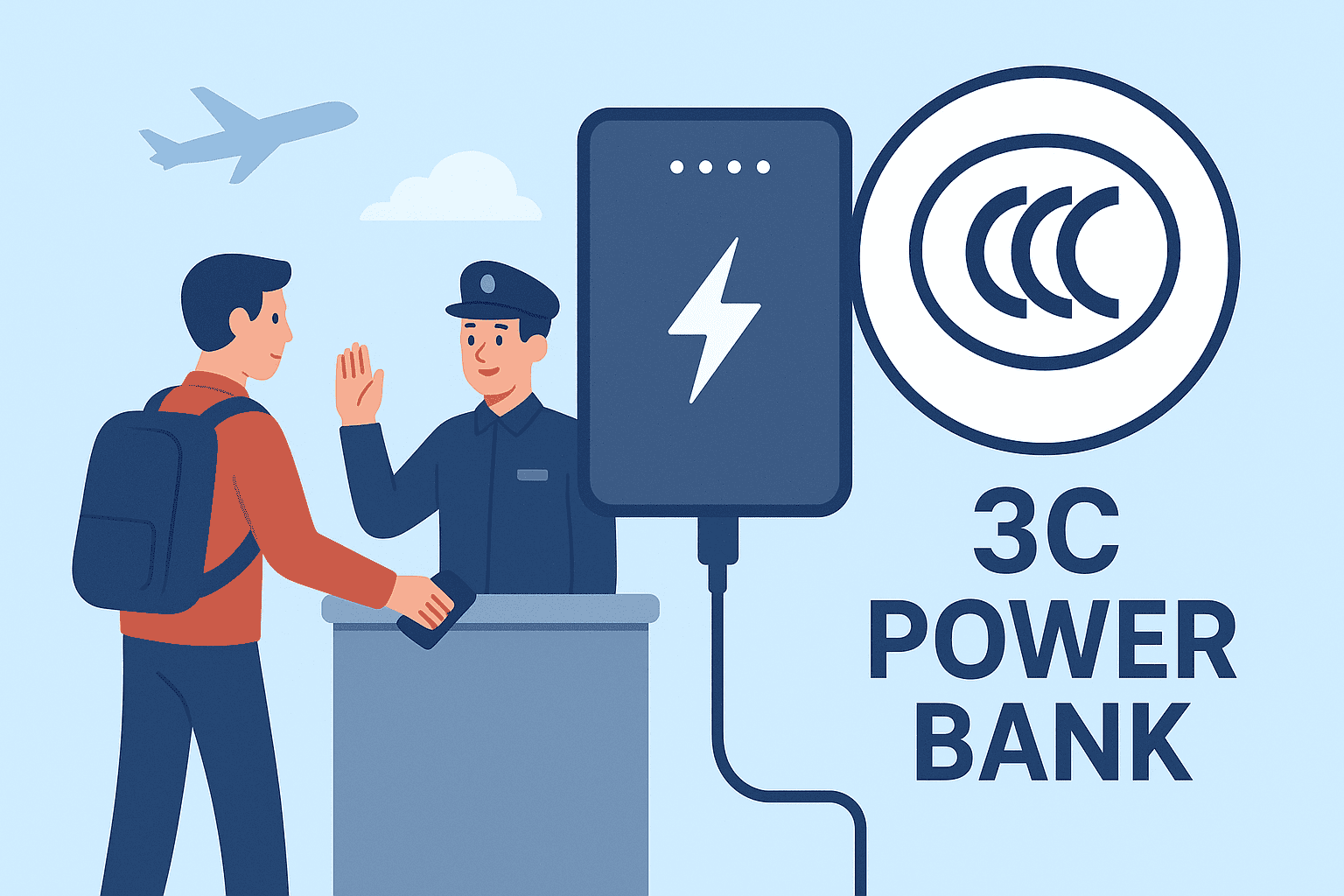
For people going to or from China, 3C certification isn’t just a label; it’s a required safety check. Airports like Beijing Capital and Shanghai Pudong have been following new inspection rules since early 2025. This means that any charger that doesn’t have a visible 3C mark can be taken away. The rule is not about brand reputation; it’s about the quality and heat resistance of batteries. Even well-known international brands that don’t have local approval get flagged. Before you pack, make sure your power bank or packaging has the “3C认证” stamp on it. It won’t fly if it’s not there.
The connection between this certification and fire safety compliance is what makes it so important. The 3C test checks the discharge rate, protection circuits, and durability of the casing of a power bank. It is stricter than the CE or FCC standards and is made just for China’s consumer electronics market. The policy may seem harsh, but it keeps both travelers and planes safe by stopping battery problems in the air. If you have to use a lot of devices during long layovers, picking a 3C-approved model will save you time, stress, and money.
Which Brands Actually Offer 3C‑Certified Power Banks in 2025
The list of brands that follow the rules is surprisingly short in 2025. Anker, Belkin, MOMAX, and Xiaomi are all global companies whose products have full 3C approval as well as CE, FCC, and UL certifications. Every brand has its own way of doing 3C: Anker focuses on fast charging and power for multiple devices, Belkin focuses on durability and laptop-grade wattage, MOMAX makes lightweight MagSafe-style chargers, and Xiaomi focuses on affordability with clean industrial design. You can find these brands in airport stores, tech chains, and trusted online stores like JD.com and Tmall Global.
Anker is still the best choice for travelers from other countries. Their A1659 and A1664 models are 3C-certified and have a good balance of charging speed and wattage that is safe for airlines. The sleek IP117A and 1-Power Pass from MOMAX have gotten a lot of attention. Both are wireless, small enough to fit in a pocket, and safe to carry on. People like Belkin’s BPB011 and BPB020 because they can power two devices at once and keep the voltage stable. These brands not only meet China’s local standards, but they also work perfectly in other places, so you only need to buy them once for multiple trips.
Xiaomi deserves a mention for offering an affordable way to stay compliant without giving up on quality. Its compact 10,000mAh models are widely sold across airports and convenience stores, and many include bilingual manuals for foreign travelers. While it may not have the same luxury feel as Anker or Belkin, it performs reliably under airline restrictions and offers PD fast charging at a fraction of the cost. For backpackers and students visiting China, Xiaomi often becomes the go-to choice. At the same time, professionals who travel frequently tend to favor Anker’s multi-device compatibility. Together, these options provide every kind of traveler with a reliable solution — from short business trips to long international routes.
Hot Models Worth Buying (Real‑World Use Cases & Specs)
Anker’s 25,000mAh A1659 is perfect for people who travel with a laptop, tablet, and phone. It has three USB-C ports that can each output 165W, which is enough to power a MacBook and charge your phone while you’re flying. The smaller A1664 version supports wireless MagSafe charging, which is great for quick top-ups at hotels or cafes without having to deal with cords. Both models have CE, FCC, UL, and 3C marks, which means they can pass through any major airport check.
Minimalist travelers love the MOMAX IP117A. It is very thin, has strong magnets for iPhones, and can send 15W of wireless power. The 1-Power Pass has an aluminum case and charges quickly via USB-C, making it great for day trips. The Belkin BPB011 has a useful 10,000 mAh capacity for phones and earbuds, and the BPB020 has 65W PD fast charging for laptops under $90, which is unusual for a certified unit. These options cover all of your needs, whether you’re on a long flight, a short commute, or a day with multiple devices.
Buying Notes & Pitfalls to Avoid (3C mark, <100Wh, counterfeits)
There are three things you should think about before you buy. The first rule is the 100Wh rule: most Chinese airlines won’t let you bring power banks that are bigger than that. Security will turn away anything bigger. Second, there are fake 3C logos, especially on cheap imports. If you can, always check the placement of the label and the serial number, or scan the QR code on the package. Third, stay away from “no-name” chargers that are sold at big discounts on sites that don’t have official stores; they almost never come with real certification.
It’s also important to remember that just having CE, FCC, or RoHS marks doesn’t mean you’re following Chinese rules. The device or box must have the CCC (China Compulsory Certificate) mark printed on it clearly. If you’re not sure, shop at well-known stores or official brand pages on JD.com, Tmall, or Amazon Global Store. For an extra ¥50 to ¥100, you can get a unit that lasts for years and passes every customs check.
Where to Buy Legit 3C Power Banks After You Land (airport, malls, Meituan/Ele.me)
Don’t worry if your charger didn’t make it through airport security. Official electronics counters at major Chinese airports, like Guangzhou Baiyun and Chengdu Tianfu, sell certified brands. Prices are fair, and receipts prove that the items are real. When you get to the city, mall chains like Suning and Xiaomi Home have full 3C selections and staff who speak English. If you’re in a hurry, order from Ele.me or Meituan. They will deliver to hotels, hostels, or train stations within an hour.
It’s surprising how reliable local delivery apps can be for electronics. Search for “充电宝 3C认证” to find verified listings that come with a warranty. Depending on the brand and capacity, expect to pay ¥200 to ¥600. There are no customs delays or risks of confiscation when you buy locally. A 3C-certified power bank isn’t just another gadget for travelers who need tech to get around, work, or remember things. It’s your ticket to stress-free travel in China.
Q&A — Common Questions About 3C Power Banks in China
Q: Can I bring two power banks on a China flight?
Yes, but both must be under 100Wh and carried in hand luggage. Airlines won’t allow them in checked bags. Keeping the 3C logo visible helps you pass inspection faster. Some airports like Shanghai Pudong may even require you to show the printed watt-hour label, so make sure it’s legible. If your device is missing this, security might ask you to turn it on or present proof of capacity — something you don’t want to fumble with in line. Travelers who carry multiple gadgets usually choose two smaller 10K or 15K options rather than one large one; it’s safer and easier to clear customs.
Q: Do international brands automatically qualify for 3C certification?
No. Even if your Anker or Belkin model has CE or FCC approval, it still needs 3C certification for Chinese airports. Always check the printed label or product details online before packing. A few global sellers now include this information on Amazon or their official site, so you can confirm before flying. If in doubt, take a screenshot of the product page showing the 3C logo — it can help during inspection.
Q: Where can I verify if a power bank is truly 3C‑certified?
You can look for the “CCC” mark on the device or search the model number on the official CNCA (China National Certification Administration) database. Avoid buying from marketplaces without verified seller information. Some travelers also use WeChat Mini‑Programs like “3C认证查询” to scan QR codes on packaging, which instantly tells you if the certificate is valid. This small check can save you from losing an expensive charger at security.
Q: Are 3C power banks compatible outside China?
Yes. Most certified units, like those from Anker, Belkin, and MOMAX, also meet CE, FCC, and UL standards, making them safe for use in the US, EU, and Asia. They’re built for global travel. In fact, some frequent flyers prefer buying their power banks in China because of the stronger safety testing. The 3C models often support PD 3.0 and multi‑port output that work flawlessly with laptops, tablets, and gaming consoles worldwide.
Q: What’s the safest place to buy a 3C power bank after landing?
Airport counters and major mall electronics stores such as Suning or Xiaomi Home are best. You can also order from Meituan or Ele.me if you need quick hotel delivery. It’s convenient, legitimate, and often cheaper than buying abroad. For a wider selection, check JD.com or Tmall’s flagship stores — they often list discounts and detailed spec sheets in English. If you’re unsure about compatibility or want to compare models, refer to the full guide on TravelofChina.com for side‑by‑side breakdowns of certified products and real user feedback.