Introduction
Engineers designing complex parts often struggle to choose between 3-axis, 3+2, and simultaneous 5-axis machining, facing trade-offs in cost, time, and precision. This stems from a limited understanding of these advanced services. This article clarifies the differences and provides a clear, geometry-based framework to guide the optimal choice in minutes.
Does Your Part Truly Have Complex Contours? How is “Complex” Defined?
The first step is to technically define “complex contours.” Not every multi-faced part necessitates full 5-axis motion. According to industry analyses on advanced machining trends, the growth in complex contour 5-axis machining is primarily driven by demand for monolithic components in aerospace (like turbine blades) and medical (like custom implants) where organic, free-form shapes are essential for function. The key is to distinguish between a part with multiple discrete planes and one with genuinely continuous, multi-directional curvature.
Three core geometric features are definitive triggers for true 5-axis needs:
1) Continuous Surface Variation (e.g., aerodynamic profiles),
2) Deep Cavities with Narrow Openings that challenge tool reach and collision avoidance, and
3) Undercuts & Negative Draft Angles impossible to access with a fixed spindle.
A part like a multi-faceted enclosure bracket might be efficiently handled with indexed machining, whereas a fuel injector nozzle with internal helical channels demands simultaneous motion. This distinction is crucial for effective Precision CNC Machining strategy.
Simultaneous 5-Axis vs. 3+2 Axis: What Are the Core Differences and True Costs?
The Motion Difference: Continuous Path vs. Discrete Positioning
The core distinction is kinematic. 3+2 axis machining positions the tool at a fixed angle, then machines in 3 axes, which is efficient for multi-sided prismatic parts. In contrast, Simultaneous 5-Axis Machining coordinates all five axes in continuous motion during the cut. This maintains the tool’s optimal orientation to the contour at every point, which is essential for achieving smooth finishes on complex, free-form geometries.
Unveiling the Cost Reality: A Total Cost Analysis
A simplistic view is that simultaneous 5-axis is always more expensive due to higher machine rates. A true analysis considers Total Cost of Ownership (TCO):
| Factor | 3+2 Axis Machining | Simultaneous 5-Axis Machining |
| Programming & CAM | Less complex, faster. | More complex, requires advanced expertise. |
| Machine Hourly Rate | Generally lower. | Generally higher. |
| Fixturing & Setups | May require multiple, custom fixtures. | Often a single, simpler fixture. |
| Secondary Operations | Often needed for different sides/angles. | Drastically reduced or eliminated. |
| Total Part Cycle Time | Can be longer due to multiple setups. | Can be significantly shorter for complex parts. |
| Best For | Prismatic parts with angled features. | True, organic 3D contours. |
- The Economic Case for Simultaneous 5-Axis
For a monolithic aerospace bracket with thin walls and compound curves, the single-setup capability of a simultaneous 5-axis machining center can offset its higher hourly rate by eliminating fixture costs, reducing handling labor, and shortening the overall project timeline, making it the more economical choice overall.
- The Strategic Use of 3+2 Machining
For parts that are essentially 3D but composed of discrete planar faces—like a complex electronic chassis or a mold base—3+2 machining provides exceptional value and efficiency without the programming overhead of full 5-axis.
For Difficult-to-Machine Materials Like Titanium, Is Simultaneous 5-Axis Mandatory?
Material properties decisively influence the process. 5-axis machining titanium alloy, Inconel, or hardened steels presents challenges like high cutting forces, poor heat dissipation, and work hardening. For these materials, Simultaneous 5-Axis Machining is often not just beneficial but essential.
The continuous tool orientation control allows for maintaining a constant chip load and the most favorable cutting angle.
This leads to:
1) Reduced Cutting Forces and Heat Generation, protecting the tool and the part’s metallurgical structure;
2) Superior Chip Evacuation, preventing chip re-cutting and tool damage; and
3) Enhanced Surface Integrity, critical for fatigue performance.
For a medical implant manufacturer requiring AS9100D or ISO 13485 certification, this capability is non-negotiable for achieving the required surface finish and dimensional stability in a single setup, thereby minimizing scrap rates.
This defines a true high precision 5-axis CNC service.
How to Quantify the Choice: What Core Performance Metrics Should You Focus on When Selecting a 5-Axis Service?
Selecting a vendor for 5-axis CNC machining services requires looking beyond basic machine specifications.
A partner offering genuine high precision 5-axis CNC capabilities will be transparent about the following:
Core Machine Performance Metrics
Look beyond basic static accuracy specs. For true high precision 5-axis CNC capability, inquire about dynamic accuracy under load (via ballbar tests), built-in thermal compensation, and vibration damping systems. These factors determine real-world precision and surface finish on complex parts.
Process Control & Partnership Evaluation
Superior process control is demonstrated through integrated in-machine metrology like probing and laser tool setting, enabling real-time verification. True partnership evaluation extends beyond certifications to assess a supplier’s proactive engineering support, transparent communication, and collaborative problem-solving approach for your specific project challenges.
- Integrated Metrology & Control
Superior 5-axis CNC machining services use on-machine probing and laser tool setting for in-process verification and adaptive control, closing the quality loop directly on the shop floor.
- Certification & Technical Dialogue
While certifications like ISO 9001 indicate a quality system, the real test is a technical dialogue. A competent partner should detail their specific strategies for your part’s material and geometry, demonstrating applied expertise beyond a certificate.
From Evaluation to Production: What are the Key Collaboration Steps in a Successful 5-Axis Project?
Successful advanced machining is built on partnership, not just transaction. Effective Custom Manufacturing Solutions involve three key collaborative phases:
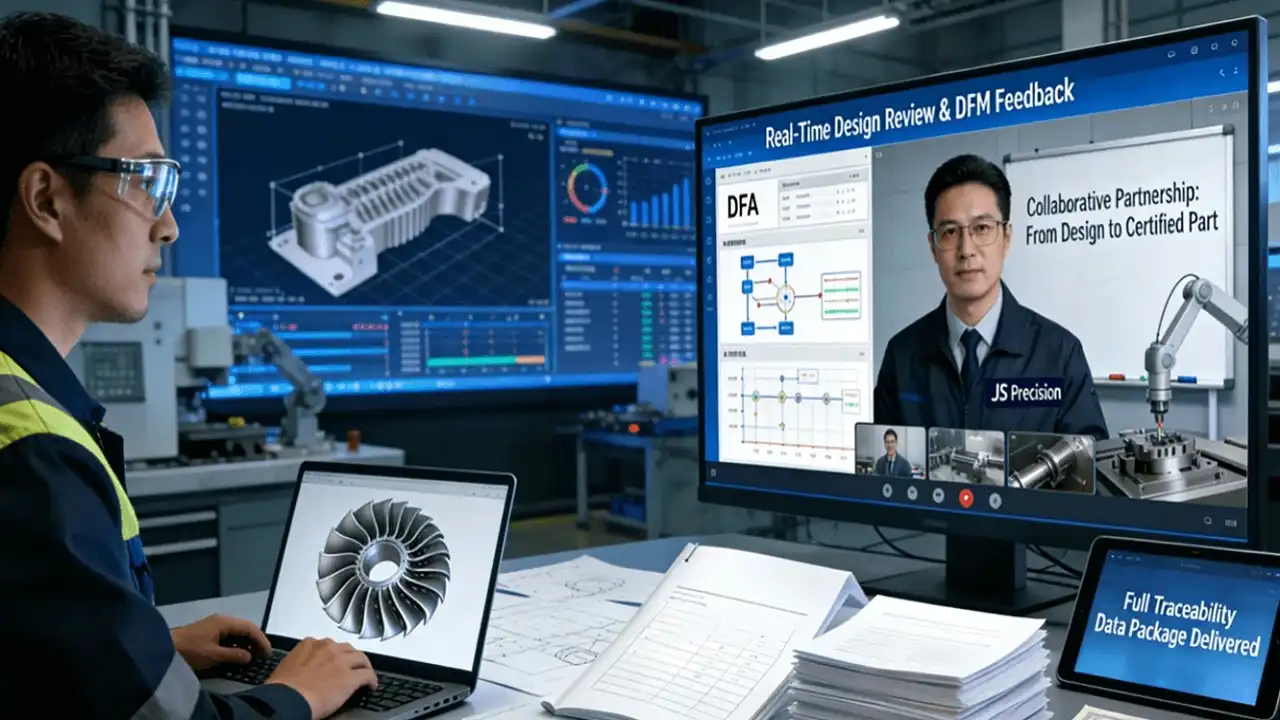
A successful partnership in Custom Manufacturing Solutions begins with proactive engineering, from a detailed DFM analysis that optimizes design for manufacturing, to a transparent quote explaining the chosen machining strategy and cost breakdown, and finally, the delivery of a complete quality data pack for traceability. The ideal partner integrates these steps within a framework of top-tier certifications. A manufacturer like JS Precision, which combines such certifications with deep engineering support, exemplifies this collaborative standard for reliable outcomes.
Conclusion
Selecting the correct 5-axis machining strategy is a multifaceted decision integrating geometry, materials science, and cost management. By systematically analyzing part contours, understanding the core difference between 5-axis motions, accounting for difficult-material behaviors, quantitatively evaluating supplier capabilities, and establishing a deep collaborative workflow, engineering teams can transform manufacturing uncertainty into a controlled competitive advantage.
Is your next complex part design ready? Upload your 3D files today for a free manufacturability analysis and preliminary quote based on the evaluation logic outlined above. Let professional insight set your project on the path to precision.
Author Bio
Zhang Ming is a senior manufacturing technology consultant with over 15 years of experience in precision manufacturing and supply chain management. He specializes in providing strategic planning and implementation guidance for advanced CNC machining and Custom Manufacturing Solutions in the aerospace, medical device, and high-end industrial equipment sectors.
FAQs
Q: Is 5-axis machining prohibitively expensive for low-volume prototypes?
A: Not necessarily. For highly complex prototypes, 5-axis machining can reduce total cost and lead time compared to multi-step 3-axis machining by eliminating fixtures and setups. The key is a detailed piece-part cost analysis.
Q: Can 3+2 axis machining achieve the same precision as simultaneous 5-axis?
A: For features on a positioned face, yes. However, 3+2 axis cannot dynamically optimize the tool angle during contour machining, so it typically cannot match the surface finish and consistency of true simultaneous 5-axis on complex curved surfaces.
Q: How do I assess if a supplier’s 5-axis machine is suitable for my material?
A: Ask for their specific machining database, tooling solutions, and cooling strategies for your material (e.g., titanium, tool steel). An experienced supplier will provide parameter examples and tool recommendations.
Q: Is 5-axis programming extremely difficult and time-consuming?
A: Yes, 5-axis programming, especially for simultaneous motion, requires significant engineer expertise and advanced software. This is precisely the value of a professional service provider—they invest expert programming time to yield shorter machining times and higher first-pass success rates for you.
Q: Besides aerospace and medical, what other industries commonly use 5-axis machining?
A: Energy (turbine components), high-end molds (for injection molding, die-casting), optical components, automotive R&D (prototypes and high-performance parts), and robotics (precision joints and actuators) are all major adopters of 5-axis technology.